
The CULTON project was initiated to create a comprehensive overview of humanity’s plant varieties (cultivars), animal breeds, and other biodiversity necessary for agriculture, horticulture, silviculture and aquaculture. On this page, we will elaborate on how we will work and what we think the project can contribute to.
On the way we have also come to the conclusion that there is a need for a reform within the systematics and name rules, and have therefore introduced a new cultonomic structure which now forms the basis of the project. The essential concept here is the culton, from where the projects gets its name. Read more about this on the systematics section.
The problem
There are many sources of biological data, both for plants and fungi, animals and cultivated microorganisms, from large official to countless private ones for various purposes. Most of the more advanced ones are built for research, public planning and management, and for large enterprises. And there is a growing array of sophisticated tools available to these groups.
There are also some tendencies in this direction at the grassroots level (private growers and smb’s), but there we have a long way to go. Accessing data, and even more, using the data, is almost impossible for this group, because the competence threshold is too high.
The absence of a “single source of truth” for the names and data about the world’s cultivars/breeds/strains leads to problems on topics like:
- name stability and standardization
- finding structured data to compare cultivars/breeds/strains
- achieving tools and standards for effective interaction among different actors
- creating systems for planing and monitoring cultivation activities
This leads to the main problem:
The lack of such a complete info source is an obstacle for future production of food and other nature based goods. This is specially the case for marginal areas and non-industrialized production carried out at the grassroots level in society, of which more than half of the world population depends.
The solution
To build such a solution, we need to focus on the following activities:
Collecting and quality-assure names of cultivars, breeds and strains
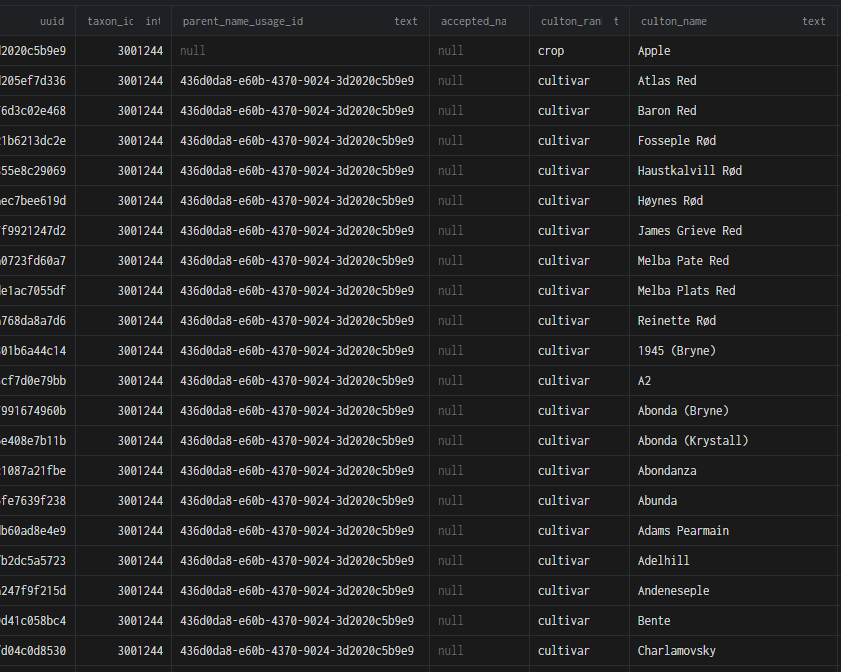
We are in the process of building a first backbone, as it is often called in bio-database projects, but tackling this task systematically will require time to develop methods and knowledge. This is one of the foundation’s core tasks, and will have to take place in parallel with the construction of the data sets themselves.
We will build a network of professionals and others who are qualified to quality check the data sets and suggestions from users.
The names we suggest will follow the theoretical basis we have developed based on the culton concept.
Developing descriptors of cultivars, breeds and strains
To expand the data sets with trait descriptions of the entries, important for the data to be used for
- planning of reproduction
- further development of new cultivars
- planning and execution of cultivation
- exchange
- use, etc.
It will be possible to develop separate systems for all these purposes, and the idea is that such systems should get updated access to such data via an API. Bi-O has already developed a system for overview (logging of inventory, cultivation and reproduction) and for exchange of material, which during 2022 has become CULTON’s sister project CULTONx.
Enriching the descriptions with images and data from the users
Via the planned CULTONx app, and CULTON’s own website, users from all over the world will be able to contribute images and data from their cultivation activities. In this way, everyone can quickly access good images for free via Creative Commons (cc) and other similar licensing.
We will develop tools and standards so that the image material will be as systematic as possible, so that everyone can use the images to compare and describe traits as precisely as possible, and so that we can build effective image searches. One criterion is that all images must have a scale and a color coding, so that they can be color corrected in image processing and compared with others by the images having the same scale.

Data about the users’ cultivation location, such as soil type, local climate and local flora and fauna, as well as data from cultivation, will be important for building up CULTON’s descriptors.
The contribution
We believe the project removes obstacles and opens up new opportunities for building the nature-based production systems of the future.
It’s no secret that the CULTON project comes from a place where the focus is to preserve as much of the planet’s ecosystems as possible, and to help the large group of poor people in the world who are struggling to survive with scarce resources at hand. That does not mean that the project is not equally important and useful for the rich industrialized part of the planet. On the contrary, we only see synergy effects in all directions from building this project.
If the project is to become a contribution to a digital backbone for the sustainable “bioanthosphere”, it must be done in a different way than in today’s industrial production:
- electricity rather than fossil energy carriers
- genetic diversity rather than monopolized and patented universal varieties
- polyculture and small monocultures rather than large-scale monoculture
- integration with local communities, rather than segregation in specialized screened-off factories
A data source with all the world’s cultivated organisms will be a prerequisite for making this happen, so that everyone, wherever they are on the planet, can find what suits where they live, and have the right diversity to choose from as climate change creates changed growing conditions:
- basis for knowledge building and dissemination in society
- more precise and effective communication in all parts of society dealing with cultivars
- precise basis for the development of new digital-based technology for advanced sustainable production systems that solve the environmental, climate and working life-related problems we have in today’s production system
- awareness of man’s dependence on nature, and hence a maturation in the direction of a new humility and gratitude for the gifts nature gives us humans
Last Updated on 2023-04-02 by Karl Aakerro